
What the Niagara County Current Owner Record Shows
Start with PROS-GAR or the current assessment roll. Result headers list the address, owners, SBL, sale date, sale price, and property type for the parcel. Views do not always show full vesting fields. That detail lives in the deed. Carry the SBL and the municipality into your comparison so the record stays tied to the correct land. Then open the recorded instrument and read its actual vesting language.
| Owner of Record | Name displayed on the assessment roll; verify against the latest deed. |
|---|---|
| Vesting / Tenancy | Read from the deed's granting and vesting language, not inferred from a summary field. |
| Mailing Address | Tax-mail address where published; it can differ from the parcel location. |
| Situs Address | Street location used to identify the assessed parcel. |
| Deed Reference | Clerk index citation for the recorded instrument that conveyed the interest. |
| Ownership Since | Compare the deed's execution and recording dates; they are not interchangeable. |
The owner of record may be an entity. It may be an out-of-area owner. The roll's mailing address can point to an accountant, fiduciary, or another notice destination rather than the property itself. That address is not a residency clue. It works as a contact route for a legitimate property matter, but a portal's displayed owner can also lag behind a newly recorded transfer, so check dates before drawing conclusions.
Confirming the Current Owner in Niagara County
Use SearchIQS to find the most recent deed. Read the instrument itself. Match its property description, municipality, and parties against the assessment SBL, since the index alone may omit terms needed to understand the conveyance. Coverage has a limit. The county's current SearchIQS description places deed coverage near 1941, while an older help page reports about 1918. Contact the County Clerk when the relevant transaction is older than online coverage or an image is missing.
- Search PROS-GAR by address or SBL, select the right municipality, and write down the owner and parcel number.
- Search the County Clerk's index for the latest deed and retrieve the image or request a copy.
- Compare the deed's grantee, legal description, recording date, and vesting with the assessment result.
- For an LLC or corporation, use the New York entity database to confirm its legal name and reported agent details, without treating those details as parcel ownership proof.
- Use the tax-mail address only for an appropriate property-related contact and record the date of the roll you consulted.
- Owner of record
- The name shown on the assessment record for tax administration.
- Vesting
- The manner and parties in which the deed states an interest is held.
- Registered agent
- A designated entity contact for service; the role does not itself establish ownership.
Reaching a Niagara County Property Owner
A property question sometimes calls for direct contact. The public tax-mail address is the record-based route when it is available. A tax notice address can differ from both the situs and a person's residence. Some addresses are legally shielded. New York's Address Confidentiality Program and confidential voter-registration protections exist for that purpose, so never try to defeat them or infer a private location from other records. A business agent is not necessarily an owner.
Lawful use. Use a published mailing address for a legitimate property matter only. Do not use owner information to stalk, threaten, intimidate, or harass a person.
Owner Fields in Niagara County PROS-GAR
The official owner-search route in PROS-GAR accepts owner names along with address, SBL, street, and municipality. The page displays an access notice before the form.
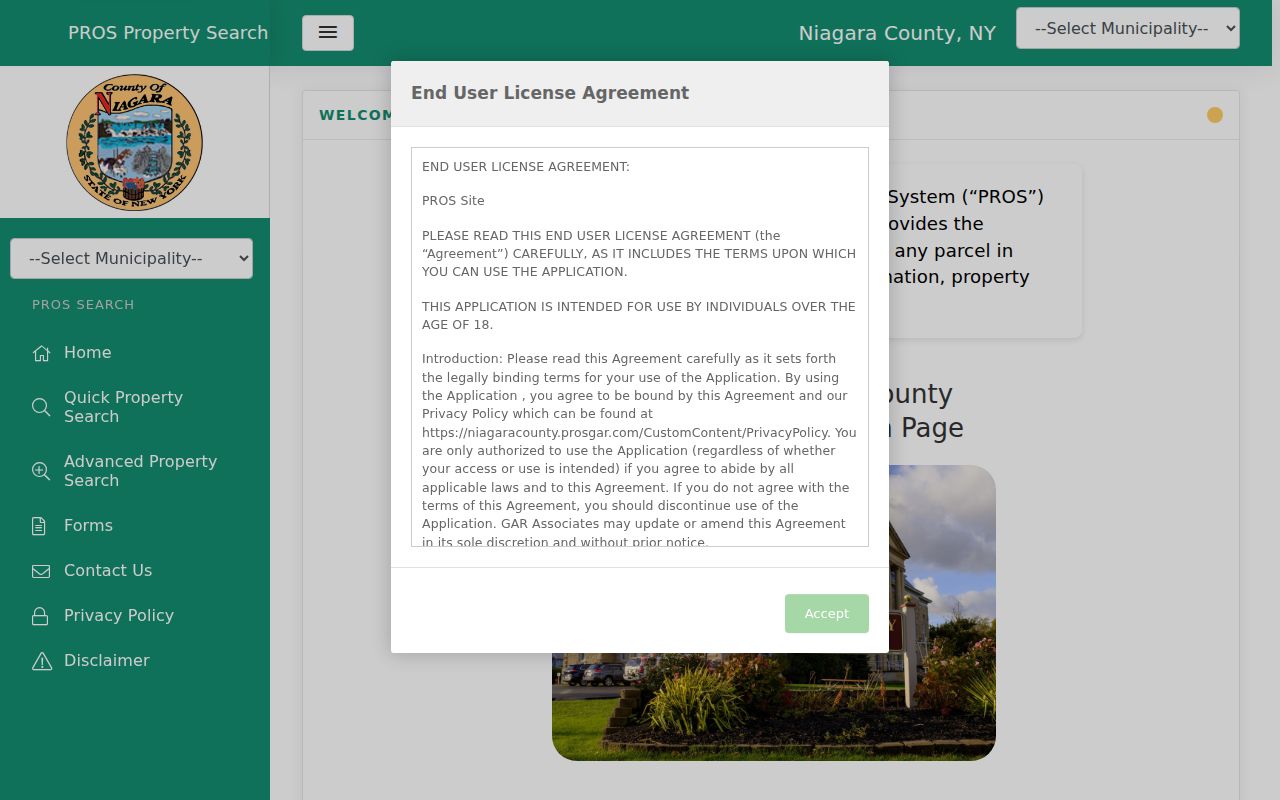
Once the form opens, run the search. Then use the returned SBL to keep the owner-of-record check tied to the correct land parcel in Niagara County.
Owner Name and Deed Date May Differ
A deed's execution date, recording date, and assessment update date describe three different events. The Clerk's image shows what was filed and when. It records when the instrument entered the land-record system. PROS-GAR reflects assessment information that may update later. The PROS-GAR notice cautions that results may be inaccurate, incomplete, or delayed, and no synchronization interval is guaranteed.
When names disagree, compare the newest available deed. Ask Real Property whether the roll has been updated. Do not assume that an older-looking name proves the transfer failed. The newest portal label never supersedes a recorded instrument.
Confirm the Parcel Before Treating a Name as Current
Street addresses get renamed, renumbered, and shared across municipalities. Confirm the SBL and municipality in PROS-GAR before trusting a name. Then open the parcel in GIS and compare its location against what you know. Carry those same identifiers into the deed description. Niagara Falls, North Tonawanda, and Lockport each have specific city labels in the county portal, while a postal address may actually refer to a surrounding town.
Entity and estate owners take extra care. Search the indexed name variants. Review the legal name on the deed; Secretary of State details can help with name normalization or service contact, but only the land instrument ties a party to the described parcel.
What a Current Owner Search Cannot Establish
A name on the roll proves little by itself. It does not show who lives in the building. It does not settle whether one party holds the entire interest, whether a mortgage remains unpaid, or whether title is free of exceptions. An index snippet is not the deed. Even a deed alone may not complete a full title examination. Ask the custodian for the official record. Use qualified title or legal advice where a closing or a legal right depends on the answer.
Keep a short note with the address, SBL, municipality, roll year, deed reference, and dates you checked. That habit keeps a discrepancy traceable.
Read the Current Owner's Assessment Entry Carefully
Read the assessment entry before drawing conclusions. PROS-GAR's result headers show the owners and the SBL. The public sample does not confirm that a full owner mailing address or a deed vesting field appears for every parcel. Open the assessment roll and note its year. Ask the assessor when a field label is unclear. Converting a portal label into a legal conclusion is a mistake no one needs to make. Current online data can lag and may be incomplete.
Also, never assume the listed owner receives mail at the parcel. The tax-mail address and the situs address serve different purposes, and some addresses may be protected. For an entity owner, verify the exact name against the recorded deed.
SearchIQS Coverage and Copy Options
SearchIQS is the County Clerk's land-instrument index. It is not a current assessment feed. The current availability sheet describes deeds from roughly 1941. An older help page gives roughly 1918. Neither date should be treated as definitive. Ask the Clerk before assuming an earlier deed is missing. Public computers and counter or written copy routes exist. Check online access terms and image prices when you use the service.
When you contact the Clerk, provide names, municipality, approximate recording date, and instrument type. An index result is thinner evidence than a copy of the deed itself. The deed description and the assessment address may disagree. Compare SBL and map references, or ask a title professional to examine the chain.
Recent Transfers and Assessment Timing
A new deed can be recorded before the assessment record catches up. Niagara County's portal terms caution about accuracy, completeness, and delays. No fixed update interval is published. Record when each source was consulted. Compare the recording date with the roll year. If the deed owner and the assessment owner differ, ask Real Property whether the roll has been updated. Ask the Clerk to confirm the recorded instrument. Never describe a result as real time. A later assessment card does not prove the deed was indexed correctly, and a deed alone may not disclose every interest or exception, so keep your evidence and dates attached to the conclusion.