
The Values on a Niagara County Property Record
Niagara County property research can surface several distinct figures. One is the assessment value, another is the taxable value after exemptions, and a third is sale information. These numbers are not interchangeable. PROS-GAR's published result headers list sale date and sale price, but its parcel views do not promise a separate full market-appraisal field for every property. Check the roll year and the local level too. The deed or assessor record shows the event date behind a sale amount.
| Value | What It Is | Where |
|---|---|---|
| Assessed value | Value on the parcel's assessment roll for a stated year. | Local assessor, final roll, and PROS-GAR |
| Taxable value | Value after applicable exemptions for tax computation. | Assessment roll and local assessor |
| Last sale price | Reported sale information; confirm it against the recorded transfer. | PROS-GAR result and County Clerk deed |
| Full-market comparison | Requires a stated local assessment level or state ratio; not a parcel appraisal. | Local roll, NYS ORPTS, or licensed appraiser |
Equalization keeps local rolls comparable. Every New York locality states a level of assessment, and NYS ORPTS publishes equalization rates and residential assessment ratios for that purpose. A ratio describes a municipality-wide relationship. It links assessed property to estimated full value across a whole town or city, not the likely price of one home. A sale price reflects one specific transaction. Assessed value is prepared for taxation instead, and exemptions can change the taxable amount without changing the underlying assessment.
Looking Up a Niagara County Property Value
Start with the county Real Property index. Locate the correct parcel and its municipality. The county page links PROS-GAR and the 2025 final assessment rolls. PROS-GAR's sample result headers include address, owners, SBL, sale date, sale price, and property type. Full value is not promised for every parcel. Request the current roll or ask the assessor before labeling any number as full value.
- Search the address or SBL in PROS-GAR and confirm the parcel's municipality and property type.
- Open the relevant assessment roll and note the roll year, assessed amount, and any exemption information available.
- Compare the reported sale date and price with the County Clerk's recorded deed and its consideration details.
- Use the local level of assessment or NYS ORPTS ratio to interpret a roll comparison; do not treat it as an individual appraisal.
- Ask the assessor to explain an unexplained value or record field and identify the current review procedure.
- Assessed value
- The roll amount assigned to the parcel before the final tax calculation.
- Market / appraised value
- A market opinion estimates likely exchange value; the portal result is not documented as a private appraisal.
- Level of assessment
- The locally stated percentage used to relate assessed values to estimated full value.
What a Niagara County Assessor Value Is Not
An assessment exists for tax administration. It applies a local valuation process to a roll year. That is not the same as predicting a sale price. Assessment level, parcel data, market changes, condition, exemptions, or the roll date can all push the two figures apart. Some of these come from assessor records. Others follow the market itself. No countywide revaluation schedule is published. Niagara County has no recent uniform reassessment cycle either. Do not infer a future value date from another municipality. A licensed appraiser can prepare an independent market opinion. That can serve a transaction or any other purpose.
Value vs price. A Niagara County assessment is not a promised sale price or loan appraisal. Compare the correct roll year and parcel characteristics, and obtain a licensed appraisal when an individual market opinion is needed.
New York Equalization Context
The state equalization-rate explanation shows why an assessed value should not be read as an automatic estimate of what a parcel would sell for. It illustrates state guidance, not a Niagara County parcel valuation.
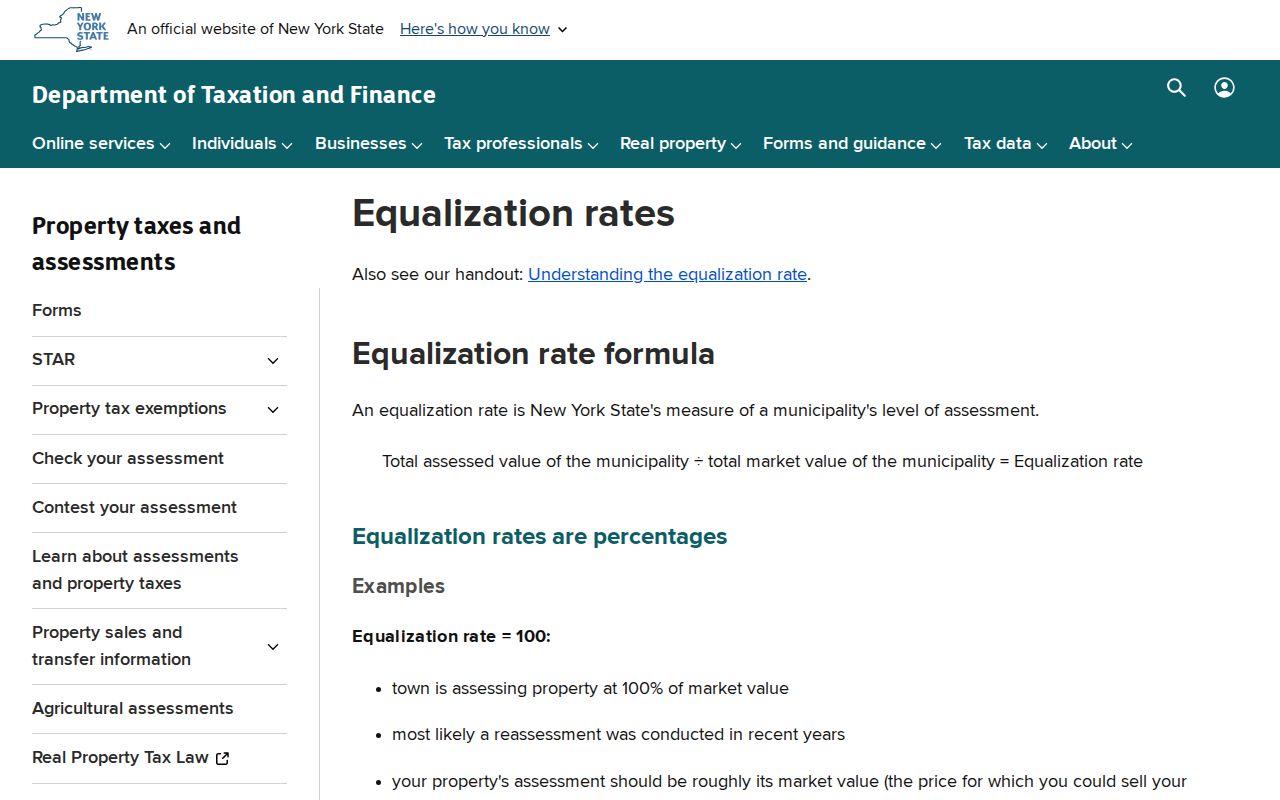
Interpreting any Niagara County value starts with the locally stated assessment level. The applicable roll year matters just as much, since equalization depends on both figures matching.
Niagara County's 2025 Final Rolls
The county Real Property resource page points to the 2025 final assessment rolls and PROS-GAR. A roll is a dated snapshot. Read it with its municipality and version. That care makes a roll useful for tracking one parcel across years, even as figures shift. No countywide revaluation year or cycle is published. If a value changed, ask the assessor whether the difference reflects a physical inventory change, exemption, correction, local assessment practice, or a roll update.
Note the SBL and roll year. Assessment databases may update after a deed. Older PDFs may remain available after newer information is posted. Comparing a 2025 roll with a sale from another year, without noting the dates, can mislead.
Sale Price, Assessment, and Taxable Amount
PROS-GAR's sample route lists sale date and sale price among its result headers. Those fields help locate a transaction. The recorded deed still governs. It verifies the instrument and description. Consideration in a deed may not say whether the sale was typical, arm's length, or comparable to another parcel. Estate transfers, partial interests, and related parties can make a recorded amount a poor market comparison.
Taxable value differs too. Review each field with its roll year. Exemptions drive the gap, so check the category as well. A tax bill then applies rates, levies, and charges to the taxable amount, and the bill itself is not a statement of market value.
Compare Parcels Carefully in Niagara County
Choose comparison parcels with care. Match municipality, land area, and building traits. Niagara Falls, North Tonawanda, and Lockport sit in Niagara County as separate city choices. Surrounding towns may state different levels of assessment. A nearby tax value is not comparable until the basis, roll date, and assessment year are understood.
No countywide comparable-sales report is offered. Use PROS-GAR and the roll to identify candidate parcels, and check transaction details in the Clerk's index. Ask the assessor what supports an amount. For a formal opinion, an appraiser can weigh condition, market evidence, and property-specific characteristics.
Questions About a Niagara County Assessment
A value that looks off needs a second look before a phone call. Confirm the situs address, the SBL, the municipality, and the roll year. Then ask the assessor which property description or exemption the figure reflects. Ask too how the current local level of assessment applies to that parcel. Want to contest it? Request the local Board of Assessment Review process and its filing date. Niagara County sets no single countywide grievance deadline.
Keep assessment questions apart from tax payment or sale questions. The collector handles bills and payment status. The County Clerk supplies recorded deeds and other instruments. The assessor explains the roll. A precise question sent to the right custodian usually resolves an apparent number mismatch in property records. It works faster than a general complaint.
Read Sale Information Beside Its Deed
PROS-GAR's sample result route shows sale date and sale price headers. Treat those numbers as a lead, not a conclusion. Pull the recorded deed from the County Clerk. Compare its parties, property description, and consideration against the reported figures. The amount may reflect a partial interest, related parties, or an estate. Any of those makes it a poor comparison with a typical open-market sale.
For a value comparison, keep the sale date and the assessment roll year separate. A deed from one year beside an assessed amount from another should never be read as two measurements. They come from different moments.
Use Local Assessment Context Before Comparing
New York's equalization rate and residential assessment ratio work at the municipality level. They relate local assessments to estimated full value. This helps when rolls use different stated assessment levels. They cannot reveal the current market price of a single parcel. Niagara County's 2025 final rolls offer a current county-linked reference point. There is no single countywide revaluation schedule. No public comparable-sales report exists at the county level.
When two values in Niagara County property records clash, confirm the same SBL, municipality, property characteristics, exemption status, and roll year first. Then ask the local assessor how the value was determined. Ask which local appeal procedure applies. For a market opinion on one specific parcel, use a licensed appraiser rather than ratio tables.