
What Niagara County Property Tax Records Show
"Tax record" covers several documents in Niagara County. The assessment roll organizes parcels, owners, values, and exemptions for valuation. A bill is separate. It applies rates and levies for one tax year, and payment or delinquency status comes from the collecting office, not the roll. Confirm the record date and the municipality first. The county Real Property page links to the 2025 final rolls and an assessment lookup, but Niagara County publishes no single countywide screen showing bill balances.
| Field | What It Shows | Where |
|---|---|---|
| Assessed value | Value placed on the parcel for the stated assessment roll year. | Local assessor, final roll, and PROS-GAR |
| Full-value context | Assessment level or state equalization ratio used for comparison; not necessarily a parcel appraisal. | Local roll and NYS ORPTS |
| Exemptions | Eligible reductions shown on the roll; verify category and parcel qualification with the assessor. | Local assessor and county Real Property resources |
| Tax bill & status | Charge and payment state for a particular bill and tax year. | Municipal tax collector or responsible Treasurer office |
| Taxing districts | Jurisdictions whose rates or levies contribute to the bill. | Bill and local tax collector |
Assessed value exists to spread property-tax obligations at the municipality's stated level of assessment. It is not the sale price. It is not the amount owed. The actual bill depends on rates, levies, exemptions, and the tax year, and a delinquent balance can add separate charges, so never work backward from a roll value to a bill.
Looking Up a Niagara County Tax Bill
Start with PROS-GAR or the current final assessment roll. That confirms the parcel's SBL, municipality, owner of record, and roll year. Then follow the county Real Property tax-resource links to the collecting office for that municipality. The split matters. An assessment database identifies and values parcels, but it is not a live payment ledger and should not stand in for one. Delinquent county charges go to the Treasurer at 716-439-7007, while ordinary current bills are usually collected locally.
- Find the parcel in PROS-GAR by address or SBL and record its municipality and assessment roll year.
- Use the county Real Property resource page to identify the collecting office for the tax type and year in question.
- Ask that office for the current bill, prior-year payment status, and any delinquent amount; provide the parcel key rather than relying on a similar street name.
- Check exemptions on the assessment record and ask the assessor whether the displayed category and owner eligibility are current.
- Request written confirmation when lien, sale, or closing decisions depend on a balance or release.
- Assessed value
- The value entered on the assessment roll before applicable exemptions and tax computation.
- Rate / levy
- A taxing jurisdiction's rate or amount used with taxable value to fund its budget.
- Exemption
- A statutory or locally administered reduction for a qualifying parcel or owner; category rules vary.
- Tax lien
- A claim associated with unpaid taxes; confirm its amount, status, and release with the responsible custodian.
Appealing a Niagara County Assessment
Start with the assessor. Confirm the parcel, roll year, assessed value, and local level of assessment before you question the number. Then ask the assessor or the Board of Assessment Review for the current grievance procedure, filing date, forms, and accepted delivery method. No single countywide calendar or form exists. Never borrow a deadline from another city or town. A good grievance names the specific Niagara County assessment and explains the alleged error with relevant records. Keep copies of everything you file.
Appeal window. Grievance dates and instructions are set locally and can vary by municipality and year. Confirm the active schedule directly with the local assessor or Board of Assessment Review before preparing a filing.
Niagara County Real Property Resources
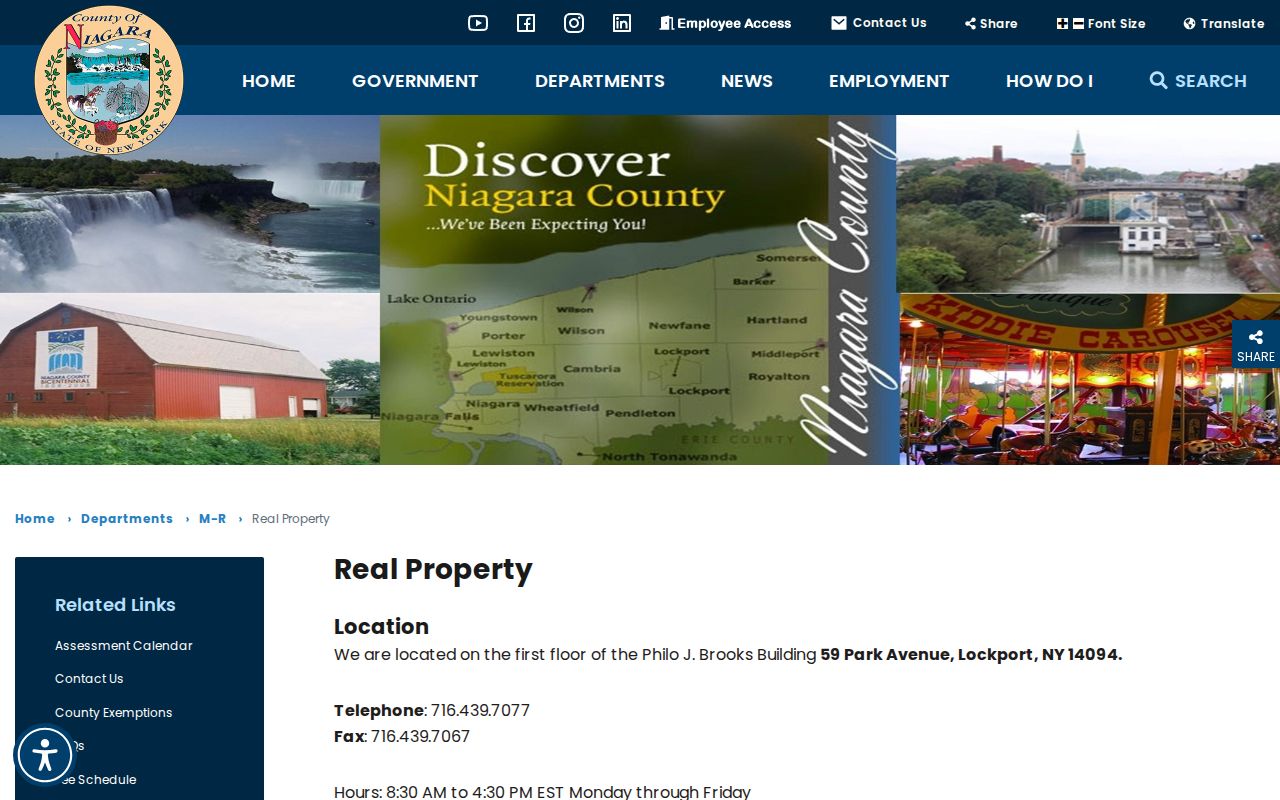
The county Real Property page links the 2025 final rolls, PROS-GAR, GIS, exemptions, and tax resources in one place. It is a resource hub, not a bill.
Keep assessed-value questions separate from payment and delinquency issues.
Niagara County Assessment Levels and Roll Years
Each municipality picks its own level of assessment. That matters in Niagara County. A number on the roll is not automatically what a buyer would pay. Context changes the meaning. Read assessed value alongside the roll year, the local level of assessment, and the relevant equalization or residential assessment ratio. The state Office of Real Property Tax Services publishes explanations and Municipal Profiles with current and prior rates for cities, towns, and villages. A 100 percent equalization rate sounds tidy. Rates below 100 and above 100 are equally descriptive. Each describes the relationship between the local roll and the state's estimate of full value, not a parcel-specific appraisal.
The county page currently points to the 2025 final rolls and the PROS-GAR database. A final roll shows assessed ownership, exemptions, and valuation. Bills do not live there. Billing and delinquency belong to the tax-collection side. Niagara County publishes no stable countywide public bill lookup. For a payment balance, a prior-year delinquency, a lien status, or a sale question, contact the office responsible for that municipality and tax year instead of inferring the answer from the assessment card.
Assessment Roll, Taxable Value, and the Bill
One property can carry several numbers at once. There is an assessed value, a taxable value after exemptions, and separate tax charges for each jurisdiction involved. Read the year beside each figure. A final roll captures valuation and parcel status at one point in the local cycle. A later deed may not show there. Corrections, exemption determinations, and bills can lag too. So save a copy or note the version and date when comparing rolls.
A bill and an online estimate will not always match. Resist blaming the portal or assuming a penalty. Ask the collector to identify the tax year, district, levy, exemption treatment, installments, credits, and any added charge. Need proof of a paid bill or a lien release? Request the record confirming payment or satisfaction. Those facts sit apart from the assessed owner and value.
Exemptions and Local Assessor Review
Exemptions show up on the county resource page. But each town and city in Niagara County administers its own. A label on last year's tax roll proves nothing today. Owners move, properties change hands, and eligibility can lapse. The local assessor handles the current application, the evidence required, and the filing deadline. So bring the parcel SBL when you call, especially near a city-town boundary line. For a value dispute, check the property characteristics on the assessment first. Errors often hide in acreage, building description, condition, or classification. Sometimes the problem is an outdated owner-of-record or exemption entry. Back up the discrepancy with documents like the deed, a survey, photographs, or a prior roll. A comparable neighboring parcel helps as context. It cannot establish that two properties deserve the same value.
Delinquency, Tax Sale, and Payment Confirmation
Exemptions sound simple. They are not. A label on last year's tax roll proves nothing about today. Eligibility and administration vary by exemption and by municipality in Niagara County. The county resource page links the programs. But the local assessor controls the current application, the required evidence, and the filing steps. Include the parcel SBL in every letter or call. That matters most when the address sits near a city-town boundary, where the right office is not always obvious.
Value questions deserve the same care. Confirm that the property characteristics and roll year are correct on your own entry before comparing similar parcels. Errors hide in acreage, building description, condition, classification, or even a name and exemption record. Support your point with documents such as the deed. A survey, photographs, or a prior roll work too. A neighboring assessment is useful context. It still cannot prove that two parcels should carry the same value.
Prepare an Assessment Grievance File
Before a local review deadline, build a tight file tied to the assessment being challenged. It should include the parcel SBL and municipality. It should also cover the current roll entry, a plain statement of the claimed error, and evidence aimed at that point. Ask the assessor or review board which forms, delivery method, and proof of receipt apply in the current cycle. Niagara County publishes no single countywide grievance date. So never borrow a deadline from a neighboring city or a prior year.
Assessment review and tax-bill disputes are two different tracks. A challenge to valuation or an exemption belongs with the assessor or Board of Assessment Review. An incorrect payment, installment, penalty, or balance belongs with the collecting office. A written reply from the responsible office can sort out which process fits. It also shows what document to request next.
Match a Tax Record to Its Roll Year
Build a tight file before the local review deadline. It should tie directly to the assessment being challenged. Include the parcel SBL and municipality. Add the current roll entry, a plain statement of the claimed error, and evidence aimed at that exact point. Then ask the assessor or review board which forms apply to the current cycle. Ask which delivery method and proof of receipt it expects. Niagara County sets no single countywide deadline. Never borrow a date from a neighboring city or a prior year.
Keep assessment review apart from a tax-bill dispute. Valuation and exemption challenges belong with the assessor or the Board of Assessment Review. An incorrect payment, installment, penalty, or balance belongs with the collecting office. A written response can sort out which process fits. It can also show what document to request next.
Assessment Changes and Tax Changes Are Different
Tax research often spans several papers. An assessment roll, a bill, a payment record, and a delinquency file may all matter. Write the year and municipality on each one. Never assume a current address lookup reflects an older bill. A final roll can shift after a correction or an exemption determination. The collecting office may hold installment and payment details that PROS-GAR does not include.
When you contact an office, give the SBL. Say exactly what you are asking about: assessed value, taxable value, a bill, a payment, or a lien. The county Real Property page is the resource hub. But the county is not the collector for every municipal charge. Check the municipality first when an address sits near a city or town border. Then ask about rates or payment.