
How a Niagara County Property Search Works
PROS-GAR is the county's practical front door. It handles address, owner, SBL, Street Finder, and municipality searches. The GIS viewer also accepts an address, owner, or SBL. SearchIQS works differently. It is organized around recorded parties and instrument types rather than a current street address. Begin with whichever detail you trust most. Then carry the municipality and SBL from system to system. A postal city or a similar street name alone will not identify a legal tax parcel.
- Search PROS-GAR by Street Address or Street Finder, and select the municipality that fits the actual parcel.
- Compare the address in the result and note its owner, SBL, sale date, sale price, and property type.
- Use the SBL in the county GIS viewer and confirm that the selected outline and municipality match the assessment result.
- Search SearchIQS by the parties to find the deed or other recorded instrument tied to the parcel.
- Contact the County Clerk or Real Property when the online record is unavailable, older coverage is uncertain, or an official copy is required.
What a Niagara County Property Record Shows
The county's published sample result route shows a compact set of fields. Look for address, owners, SBL number, sale date, sale price, and property type. Those labels help confirm that a candidate parcel is the right one. The static view, though, cannot establish every field in the live parcel detail. Treat assessment, exemption, tax-balance, and mailing details as items to verify. Check them against the current roll. You can also confirm them with the responsible office. Don't assume they appear in every search view.
| Owner of Record | current owner names on the roll |
|---|---|
| Situs / Mailing Address | situs address and separate tax-mail address |
| Parcel Number (APN) | tax-map section, block, and lot identifier |
| Assessed / Market Value | assessment values tied to the roll year |
| Legal Description | the deed.s legal description |
| Last Sale | reported sale data and deed reference |
A property search never replaces a title examination, survey, or tax-payment confirmation. The owner on the assessment roll is an owner of record for assessment purposes only. Recent conveyances may not have reached the roll yet. For a transfer, read the recorded deed itself. For a boundary, compare the legal description and recorded maps. Then consult a surveyor. For a balance, ask the collector responsible for that municipality. Be sure to name the year.
Search by Address, Owner, or Parcel
Address search works best when the situs number is current and distinctive. Street Finder helps when an older directory or deed uses a prior number. It also helps when the number is unclear. Owner search can surface parcels held under one name. PROS-GAR guidance calls for entering owners as last name, first name. Prefix a surname with an equals sign for exact-surname behavior. Organizations, estates, trustees, and common surnames may need several variants. An SBL is the strongest cross-system key once it is verified. Check it against both the address and the municipality.
| Search Key | Best For | Where It Works | Watch Out |
|---|---|---|---|
| Address | one identified parcel | PROS-GAR and county GIS | historic address changes |
| Owner name | parcels indexed to the entered owner | PROS-GAR and SearchIQS | entity names and ambiguous parties |
| Parcel number | one parcel across county systems | all county record systems | punctuation and SBL formatting differences |
Not a title search. Search results summarize records that have been indexed; they do not certify ownership or rule out unrecorded interests. Use a qualified title professional when a transaction or legal right depends on a complete chain.
Reading Niagara County Search Results
The official sample-result route publishes the result headers, but the display stops at the portal access notice. Read it as a header list, not a visible result card.
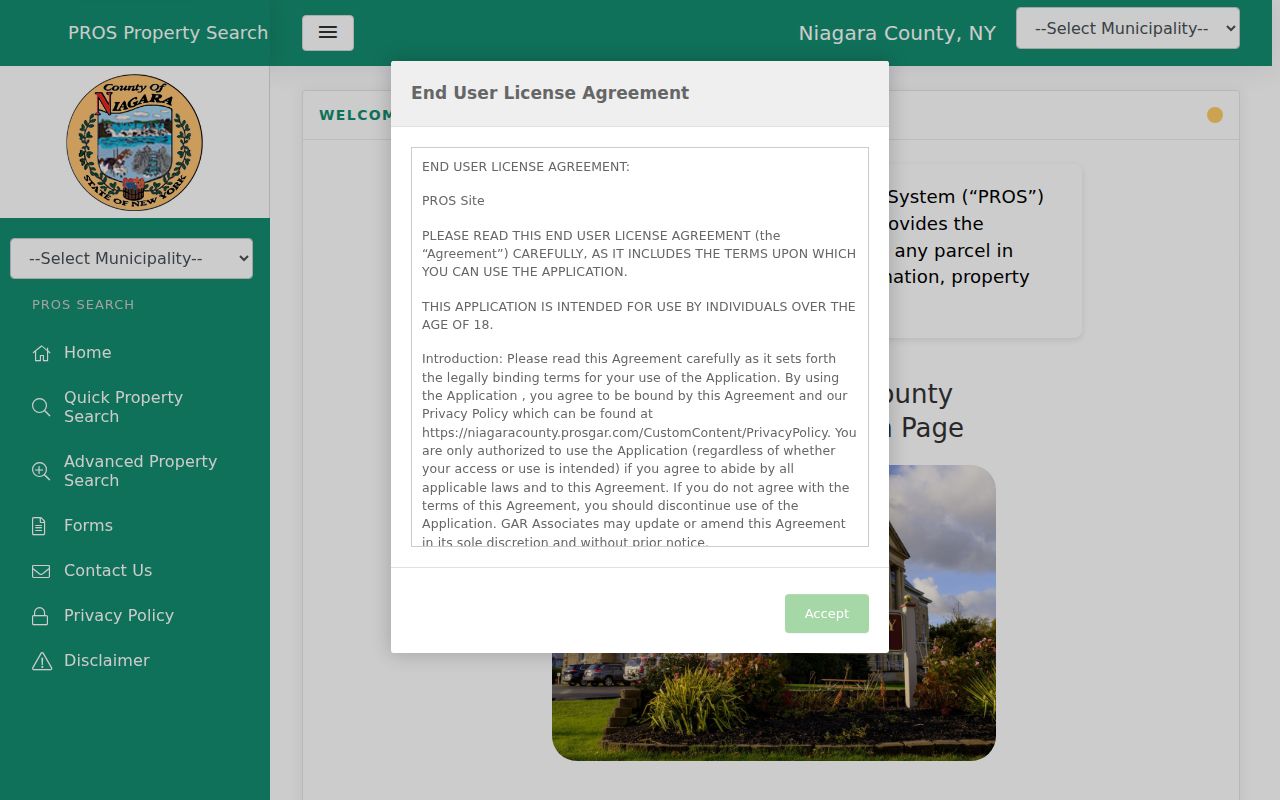
Once past the notice, compare the displayed address, owner, SBL, sale date, sale price, and property type against the parcel you meant to find.
Niagara County SearchIQS and Assessment Search Are Different
PROS-GAR is an assessment and parcel lookup. SearchIQS is something else entirely. It is the County Clerk's index for recorded instruments, including deeds, mortgages, releases, liens, and maps. A street address that works for assessment parcels may not be an index key in the deed system. Transfer research usually follows grantor and grantee names plus the instrument date. Keep separate notes for the assessor's SBL and the Clerk's book, page, or instrument reference. SearchIQS access is subscription based for much of the online index and image service. The county's published material lists a one-day access option and per-image charges. But check the current fee schedule before buying. Public computers at the Clerk's office, counter copies, and written requests are alternatives when online access falls short. Do not treat a search result as complete until the instrument image and legal description have been reviewed.
Resolve Address, Municipality, and Parcel Mismatches
Several Niagara County locations make jurisdiction checks especially important. PROS-GAR uses the choices City of Niagara Falls, City of N. Tonawanda, and City of Lockport. A mailing city may also describe an address in a surrounding town. Niagara Falls area postal ZIPs and Lockport's 14094 mail area do not define a city boundary. They cannot stand on their own as city limits. Confirm the result municipality. Then open the same SBL in GIS before using a city permit form or tax collector. A search may return multiple candidates. Compare street suffix, neighboring streets, owner, property type, SBL, and map position. Search old street names or a range of likely house numbers for historic sources. Record which alternatives you rejected and why. That discipline pays off later. It makes a deed or roll discrepancy easier to resolve with Real Property or the Clerk. You avoid restarting from an ambiguous address.
When a Niagara County Online Search Comes Up Empty
An empty result rarely means the record is gone. A typo will hide a match. So will an old street designation, a name variant, or a municipality mismatch. An index cutoff can too. So can a record type the portal does not expose. Try the SBL from a tax bill. Try Street Finder, initials, entity variants, and the map context of the adjoining parcel. Older deeds need care. One county source describes online deeds from about 1941, while an older SearchIQS help page says about 1918. Ask the Clerk which index covers your year. Treat neither online cutoff as definitive.
For records outside the routine, New York's Freedom of Information Law offers a written request channel. Describe the parcel, record type, office, and approximate date range precisely, and expect an acknowledgment with an estimated response date if the agency cannot make a final determination within five business days. FOIL does not open every record, since exemptions and copy rules still apply.
Niagara County Search Keys That Resolve Difficult Matches
The owner field works best in last-name-first order. Put an equals sign before a surname to request exact-surname matching, which can shrink a broad result set. Estates, trustees, executors, companies, initials, married names, and spelling variants still need separate searches. When an entity appears, the New York Corporation and Business Entity Database can help. It may list the current name, formation jurisdiction, county, status, service-of-process address, and agent. That record explains the name. It does not replace the deed.
Street Finder works differently. It returns the addresses along a public road. That helps when the number is uncertain, when neighboring parcels matter, or when an older source uses a changed number. Search the number and street without overloading the suffix. Then narrow by municipality. Once the right result appears, carry its SBL into GIS and keep the owner name for SearchIQS. Situs, tax-mailing, postal, and deed-description addresses can all differ without pointing to different land.
A failed online search is not proof that no record exists, since session-driven parcel details, spelling, punctuation, an old street designation, an indexing cutoff, or subscription access may be the obstacle. Use the County Clerk's public terminal for recorded instruments. Real Property or the local assessor answers roll questions. The GIS viewer settles parcel identity. The right city office handles permits. FOIL requests agency records that are not routinely posted, subject to exemptions and reasonable-description rules.
Choose the Niagara County Search Field That Fits
PROS-GAR offers several distinct ways to search. Street Address works best for a known situs. Street Finder helps when the number is uncertain or a whole road's addresses need review. Tax Map Number is also called SBL. It is the most precise parcel key shared between the assessment database and GIS. Municipality narrows results to the right city, town, or village roll. The owner field expects names in last-name-first order. An equals sign before a surname triggers exact-surname matching. Whatever field you choose, confirm the parcel the system returns.
When typing an owner name, try the indexed spelling before adding initials or punctuation. The record may instead carry an LLC, estate, trust, executor, or trustee. Run each variant separately, then compare the SBL and legal description. A matching surname alone proves little. Let the question you are answering, not the quickest result, decide which field you use.
Keep Search Results Reproducible
For every candidate result, note the exact query, portal, access date, municipality, and SBL. Write it all down. Preserve the displayed address, owner, sale date, sale price, and property type, then open the parcel in GIS to check the map location. A later search may differ. Your notes show whether the address key, municipality, database version, or deed date changed. A screenshot is not a certified record.
Keep assessment and deed references in separate fields of a working note. The SBL is a tax-map key. SearchIQS uses recorded parties and instrument citations. A portal result can guide a follow-up without proving the deed chain is complete or that a reported transaction was a typical sale.
Request Records That Do Not Appear Online
Ask the custodian first. The record may sit elsewhere entirely. It could hide under another municipality, name form, date range, or document type. The County Clerk offers public computers and copy routes for land instruments. For records a New York agency does not routinely post, submit a written FOIL request with the parcel address, SBL, record type, and approximate date range. Describe the record clearly. Staff must be able to locate it.
New York FOIL generally requires an initial response within five business days, either granting access, denying it with reasons, or acknowledging the request with an approximate response date. Exemptions still apply. Paper copies up to 9 by 14 inches are generally capped at $0.25 per page where applicable, and an appeal is normally due within 30 days. Confirm current instructions and permitted reproduction costs with the agency.
Use Niagara County Municipality Labels Precisely
The city menu on the portal lists three options. These are City of Niagara Falls, City of N. Tonawanda, and City of Lockport. Their codes are 2911, 2912, and 2909. Treat those numbers as municipality identifiers, never as parcel prefixes. A mailing city or ZIP can reach beyond the legal city limits. That gap trips up address-based lookups. Always resolve a candidate through its municipality selection and SBL instead. This matters most in Lockport. There, a single mailing address may sit in either the city or the town.
Older records pose a different problem. A deed or directory may give an address that returns no result at all. When that happens, search the street name alone. Skip any assumptions about its current suffix or number. Street Finder will surface nearby address candidates; compare their parcel numbers on GIS, then use the Clerk's map or deed reference to confirm the historical description points to the same lot.